IFS therapy

Cornell, LSU, and Sexual Violence on College Campuses

To All Survivors, I see you. I believe you. Your stories matter. Your feelings are valid. If you need to turn off the news and social media to take care of yourself, do it. If you want to be up to date on all the reports because that is what helps your system, that is ok too. So is everything in between. Call a loved one. Take a walk. Scream. Journal. Call a therapist. Binge your favorite show or book. Listen to music. Be creative. Get out into nature. Take a nap. Take care of yourself in the ways that work best for you. You’re not alone.

It’s been over a decade since I worked in higher education. Our campus was part of a grant from the DOJ Office of Violence Against Women Grant to Reduce Sexual Violence and other crimes. We had peer education groups, bystander intervention training, consent training, Take Back the Night, task forces with representatives from various departments all committed to preventing violence and supporting survivors. It was hopeful. It was empowering. These students now had the language, knowledge, and resources that many hadn’t before. We were making campuses safer,

Well this week’s news has proved that is not always the case. A college student at Cornell was raped by 7 boys for hours. There was a group chat of over 50 students who knew and did nothing to stop this crime. We learned those that perpetrated this crime faced little consequences. An essay? Really?! Also, a LSU football player aped a fellow student and admitted it. He also faced little consequences. He received a shorter than standard suspension which he appealed and he continues to play football.

WTF?!?!?!

Every women I know has experienced sexual violence or someone they are close to has. Every single women has experienced some kind of sexual harassment. Every. Single. One. Perpetrators are peers, dates, family members, community leaders, partners, and sometimes strangers. The assumption that these crimes are rare and perpetrators are strangers in dark alleys has been long since debunked. And these crimes haven’t stopped.

Teaching consent isn’t enough. Rape is about entitlement, power, control, and essentially seeing the other as an object there for the taking with no rights. There are plenty of people in power who are known predators but still became a judge, a police officer, a professional athlete, a president… But wait, don’t they say rape accusations ruin mens lives? There is plenty of evidence that this is rare.

The victim, the survivor, the woman (often but can be any gender) is the one whose life is forever changed. Their sense of safety and trust forever change because their body has experienced a home invasion. Yes with support they can work towards healing.

Women have been taught for years to hold their keys, use buddy systems, watch drinks, and more. Then when a crime happens they now have the responsibility of healing their trauma and deciding what if any steps they take towards getting some kind of justice. The justice system is often re-traumatizing. Survivors should be empowered and supported in making the best choice for them. The fact that it’s their responsibility to do whatever they can to prevent this crime and then if it does happen it is now their responsibility to heal, report, advocate for themselves, be a “perfect victim” etc… is total BS. This is exhausting! It’s not right.

All of this could have been avoided if that perpetrator just paid attention when learning about consent and applied it. It’s really not hard to not sexually assault someone. A few tips include ask and respect the answer, don’t drug anyone (alcohol included), and make sure the person can give consent (not impaired by substances, not being coerced or intimidated, etc). Why is this so hard for some?! Additionally, if you see your friend being a jerk trying to harm someone step in and stop it or get someone who can. Rape isn’t just about sex. Rape is about entitlement, power, control, and dehumanization of another person.

The Cause of Rape is Rapists.

That is who is responsible. That is where the consequences and punishment should fall.

There needs to be more systemic changes. Health education starting at a young age should include comprehensive sex education, more on consent, definitions of sexual assault and rape, bystander intervention, empathy & compassion training with how to support a friend, and support resources for if a crime does happen. Parents need to have these conversations. Schools need to have these conversations. Mentors from all areas (ie the arts, athletics, greek life) need to reinforce these messages. Every college campus should have sexual assault prevention programs, bystander intervention training, judicial advocates for survivors, and multidisciplinary task forces made up of various campus departments working together to stop these crimes from happening and supporting survivors when they do. When a crime is reported, it needs to be investigated and those responsible need real consequences. Expulsions not essays. It should have a lifelong impact on that person who committed the crime. It should impact where they can work and what power they can hold. We shouldn’t be electing them or appointing them as judges.

We all have an important part to play. You are either part of trying to make the world better, safer, and supporting survivors OR you are complacent and culpable of allowing sexual violence to continue.

If you are a survivor who is experiencing an increase in symptoms in response to hearing about these crimes in the news, support is available. As of today, I currently have 1-2 openings for new clients. If you need a help finding a therapist in San Diego reach out. If our availability doesn’t match, I’ll help you find a therapist. You deserve support.

Survivors, I believe you. It was not your fault.

If you have been impacted by sexual violence and need support call the National Sexual Assault Hotline 800-656-HOPE (4673). Contact the Crisis Text Line for free 24/7 support and crisis intervention by trained volunteers text HOME or HOLA to 741-741. If you are in San Diego, call the Center for Community Solutions 888-385-4657. Supporting Survivors of Sexual Violence is one of my passions. To schedule a consult or to inquire about availability for appointments, contact me.
Podcasts Featuring IFS Therapy

I get so excited when I hear about the impact IFS Therapy is having and when I hear it getting the attention it deserves. I first experienced IFS as a client when I was in my late 20s. My therapist and learner parts were immediately drawn to the model. It made sense to my system. Not only that, I felt something shift within me… the therapy works! I immediately signed up to attend a one week training with Dr Richard Schwartz in Cape Cod. After that, I went on to sign up for Level 1. It has been both personally and professionally life changing.

I love how nonpathologizing IFS is. When we get curious and extend compassion to our parts, we realize what they are trying to do makes total sense. These parts are stuck and are no longer helping us in the way they originally intended. They don’t have all the information and we can help get them up to speed so these parts can take on their preferred roles. We can release the burdens our vulnerable parts have been carrying.

The IFS community has grown so much. I completed IFS Level 1 training in Boston in early 2012. Back then I didn’t know many therapists who were using this amazing model, but there was a growing community in New England. When I moved cross country to San Diego, I knew even less therapists locally using IFS. That’s not the case any more though. IFS is mentioned frequently in online communities by therapists, therapy clients, and individuals doing their own self study using the model. Another place where I’m hearing about IFS therapy therapy more is on podcasts. One of the cool things about learning about IFS therapy on podcasts is that sometimes they feature IFS founder Dr Richard Schwartz doing a piece of work. Here are some podcast episodes that feature IFS.

Huberman Lab

How to Achieve Inner Peace & Healing | Dr. Richard Schwartz

We Can Do Hard Things

Inside an Internal Family Systems (IFS) Therapy Session with Glennon & Richard C. Schwartz

Abby & Amanda’s IFS Therapy Sessions with Richard Schwartz: Why We Do What We Don’t Want to Do

The Healing Trauma Podcast

Healing Childhood Trauma Using IFS

Raising Good Humans

Make Peace with Your Anger Through the Internal Family Systems Model

For a more extensive list of podcasts featuring IFS see the IFS Institute website.

If you are interested in working with me using IFS therapy send an email or message me through this website.

IFS featured on “We Can Do Hard Things” Podcast

I get so excited when therapeutic modalities that I love and practice are getting publicity. It means that a wider audience can experience the benefits that I have experienced both personally and professionally. A popular podcast recently highlighted Internal Family Systems Therapy (IFS). The “We Can Do Hard Things” Podcast with Glennon Doyle, Abby Wambach, and Amanda Doyle had guest Richard (Dick) Schwartz, the Founder of IFS, on for two episodes. The episodes included on air IFS sessions with Dick. It gives listeners a taste of the powerful work that can happen with IFS.

One of the reasons I love IFS is that it’s non-pathologizing. There are no bad parts. Sometimes there’s a part (ie people pleaser, substance user, perfectionist…) that may be stuck in an extreme role, but ultimately it’s trying to help you. When we get to know the part, we can understand it more and we can help it get into its preferred role. Often times, these parts are trying to protect us from feeling a vulnerability, a core wound, an exiled part (ie i’m not lovable, the world isn’t safe…). Our parts are often frozen in time. When we get to know them, we realize how young they are and how young they think we are. We don’t just have an inner child. We have many “inner children”. With IFS we can help them know that they are not alone. They don’t have to take the driver seat. They have us.

With IFS we can become more Self Led. We all have an inner wisdom. Self is calm, curious, compassionate, clear, confident, courageous, creative, and connected. Our parts have access to this self energy, but sometimes they don’t know that they do. Through IFS therapy and getting to know our internal world we can build that relationship. Our Self can be in the driver seat more.

These two episodes of “We Can Do Hard Things” help to give a better sense of what IFS therapy involves. If you’re ready to begin the journey of building the relationship with your internal system, contact me to set up an appointment. I look forward to working with you.

Inside an Internal Family Systems (IFS) Therapy Session with Glennon & Richard C. Schwartz

Abby & Amanda’s IFS Therapy Sessions with Richard Schwartz: Why We Do What We Don’t Want to Do

Reflecting on 2020 and Starting 2021

I have not written a blog in about a year. 2020 was A LOT. So far 2021 is too. I don’t know about you, but I found myself not having as much to give. Energy felt like it was already going outward in so many directions. One of the biggest places was in simply getting through everyday tasks. The Covid19 Pandemic is something that none of us could have prepared for. There was no play book for how to balance the pressures of “stay at home”, family, careers, health concerns, changes in finances, and more.

We have been living through a collective trauma together. I made a commitment to myself early on in the pandemic to give myself grace and make an effort to practice self compassion. It was going to be ok to just do “enough” and to focus only on the things that absolutely had to be done. I would take the pressure off myself to do any of the “extras.” Blogging became one of those extras. I kept my business social media active through both Facebook and Instagram. Meeting with clients through telehealth, maintaining business social media, attending a lot of zoom calls (both professional and personal), family responsibilities, and a few other professional responsibilities became my “enough.” Writing blogs could wait.

Still… I couldn’t help but think about all of the big events that were happening in 2020. It felt like I had a responsibility to address them clinically in a blog. Then my system became totally overwhelmed because of the number of events. There was also the pressure I put on myself to write the “perfect” blog that would do them justice. I just didn’t feel like it was or would ever be possible.

I want to take this opportunity to name some of these big events and topics. I want to invite you to join me in noticing what happens within your system as you read the words. Each could have blogs dedicated to them. They all bring up many different thoughts and emotions. These events and topics include: covid19 pandemic, election year, public figures accused of sexual violence, systemic racism, corruption, antisemitism, racial injustices, virtual learning, working from home, Black Lives Matter, health care crisis, lack of accessibility to services, inequalities in various systems, alleged election fraud, riots, protests, wildfires, deaths of civil rights and equal rights icons, families separated at boarder, conspiracy theories, insurrection, division within the country, division within families, new President, first woman Vice President (and first BIPOC), and so so much more. Disclaimer that these are just a portion of the events/topics and many of these things have been happening for years. And Breathe. My system gets activated just naming them. I have to remind myself to slow down and come back to the breath. Inhale. Exhale. Repeat.

One thing that I do when I start to feel overwhelmed is to over-saturate myself with information. Yes, in some ways that seems totally counter indicated. Yet, it helps make my system feel better. This became one of my coping strategies for 2020. I started reading, watching, listening, and reflecting. Some of the movies that I’m still thinking about include:

  • The Social Dilemma (2020)

  • 13th (2016)

  • American Son (2019)

  • Just Mercy (2019)

  • Unfit: The Psychology of Donald Trump (2020)

  • The Man Card: White Male Identity Politics from Nixon to Trump (2020)

A blog could be written on each of these. There is so much to process.

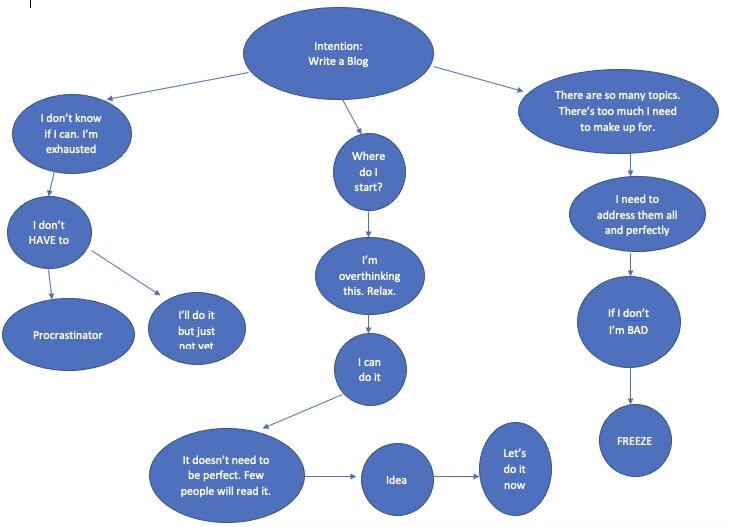
If you, like me, have something that you have been wanting to do or another challenge you’re facing, I want to offer you this invitation. Start by making that first step. Set that intention. Then notice what thoughts, emotions, and parts of you come up in response to that intention. Be curious about those and follow them to the next. Make space to acknowledge it all. It can be helpful to write it down. In IFS, we call this mapping parts. In that, there are additional prompts to consider as you continue to get to know your internal system. In CBT, we call this thought mapping. This exercise also reminds me of the brainstorming maps in creative writing classes from when I was younger.

Today, I did this exercise in an IFS training that I was a program assistant for. Here’s what came up for me when setting the intention to write a blog.

mapping blog.jpg

Again, this type of exercise can be helpful when you have a goal or a challenge. At the top of the paper write the intention or challenge. Then notice what different emotions/thoughts/parts it brings up. Be curious about each and notice what they bring up. Continue to follow these steps as you learn more. This exercise helps us to externalize all those thoughts and emotions that are inside our system. Putting them down on paper changes our relationship with them. We have a different perspective now that we have space. Sometimes, simply making room to acknowledge them is enough to initiate next steps. Other times, we may identify a thought/emotion/part that we need to do more work with before we can take action.

This past year has been filled with many challenges. If you focused on taking care of the day to day tasks and other goals took a backseat, that is ok. It helped get you here today. If you have a little trouble getting started when you are ready to revisit those goals, that’s ok too. You are not alone. I had that same struggle. Now here I am on Super Bowl Sunday writing a blog about it. Sometimes getting started is the hardest part. It starts with one step, and in this case, one blog.

Until next time…